

TL;DR: Design scalable, cost-efficient serverless systems using Cloud Run for real-world production use.
In my experience, the biggest advantage of Google Cloud for a growing startups or enterprises is the ability to go fully Serverless. By leveraging Cloud Run, I can build a microservices architecture that scales from zero to thousands of requests instantly, ensuring my clients never pay for idle CPU time.
But a serverless backend is only as good as the entry point. Here is how I architect a secure, enterprise-grade serverless stack.
When I deploy Cloud Run for a production environment, I move beyond the defaults to ensure enterprise-grade reliability:
1. Secure VPC Integration: I don’t let serverless mean “publicly exposed.” I implement Direct VPC Egress to ensure your Cloud Run services can securely communicate with internal resources like Cloud SQL or Memorystore without traversing the public internet.
2. Zero-Trust Identity: I leverage Service Identity and IAM-based authentication. By assigning unique Service Accounts to each container, I ensure that service-to-service communication is governed by the principle of least privilege.
3. Sidecar Orchestration: For complex workloads, I utilize Cloud Run Sidecars. Whether it’s running a Cloud SQL Proxy, an OpenTelemetry Collector, or a local cache, sidecars allow me to add operational depth without bloating the primary application container.
4. Traffic Management: I use Traffic Splitting and Revisions to enable safe deployments. This allows for Blue/Green deployments and Canary releases, ensuring that we can test new features on 5% of traffic before a full rollout.
My serverless architecture decisions are guided by the SCALE Framework — specifically the Cloud-Native and Automation/IaC pillars. Cloud Run is the right compute choice when the workload is stateless and doesn’t justify GKE node pool overhead.
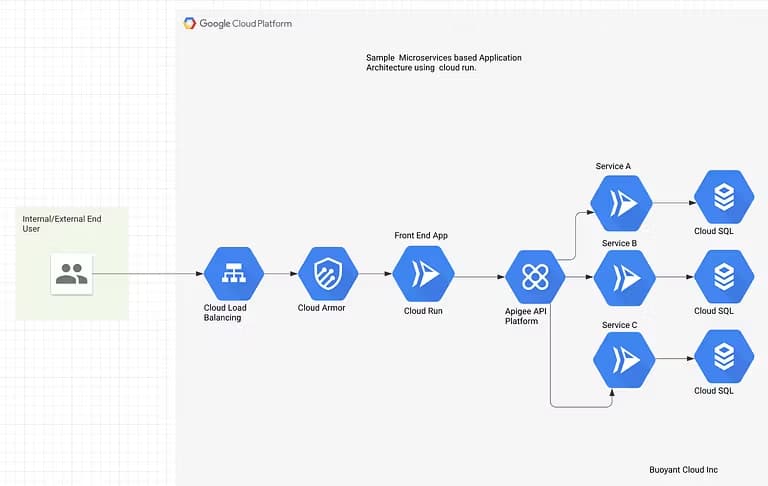
I never point a domain directly at a Cloud Run service. Instead, I use a Global Cloud Load Balancer. This provides a single, high-performance Anycast IP for the entire application.
Edge Security: I layer Cloud Armor here to stop DDoS attacks and SQL injection before they reach my compute layer.
Cold Starts: By using a global balancer, I can better manage traffic routing to ensure the best performance for end users.
The diagram shows Apigee sitting between my Front End and my backend services. In a serverless architecture, Apigee acts as the traffic cop.
Request Mediation: I use Apigee to handle the “heavy lifting” of authentication and rate limiting.
Scaling Protection: Even though Cloud Run scales effortlessly, my databases might not. I use Apigee to enforce quotas, protecting Service A and B from being overwhelmed by a sudden traffic spike.
This is the heart of my Serverless Architecture. Each block (Service A, B, and C) is a decoupled Cloud Run service.
True Pay-As-You-Go: I configure these services to scale to zero. If Service C isn’t called, it doesn’t exist in my billing report.
Event-Driven Potential: While this diagram shows a request-response flow, I often extend this using Pub/Sub to trigger these services based on events, making the entire system truly reactive.
Even in a serverless world, data needs a home. I use Cloud SQL for each microservice to maintain strict data isolation.
Identity-Based Access: I don’t use passwords in my code. I use IAM Database Authentication so my Cloud Run services can connect securely without managing static credentials.
Performance: I place these databases in the same region as the Cloud Run services to keep latency under 10ms.
| Architecture Pillar | My 2026 Choice | The Serverless Benefit |
| Compute | Cloud Run | Scale-to-zero; no VM management. |
| API Edge | Apigee | Policy-based scaling and security. |
| WAF | Cloud Armor | Adaptive protection at the Google Edge. |
| Database | Cloud SQL | Fully managed, auto-scaling relational data. |
I choose this model for startups because it eliminates “Infrastructure Toil.” My clients don’t want to manage GKE clusters or patch OS versions; they want to ship features. By moving to a Serverless Architecture with Cloud Run, I give them the power of a global infrastructure with the operational overhead of a single script.
Stop paying for idle servers. I can help you migrate to a high-scale Cloud Run architecture that grows with your users, not your overhead.
More about my background and approach →
Related Reading
In my experience, the power of Cloud Run lies in its “Containers-as-a-Service” model. It gives you the simplicity of Serverless (scaling to zero, no server management) while maintaining the flexibility of containers. You aren’t locked into a specific language or runtime, which is vital for long-term architectural health.
It radically reduces “undisplayed heavy lifting.” By offloading the infrastructure layer to Google, I help my clients focus 100% on product features rather than patching OS kernels or managing GKE clusters. This usually results in a significantly faster release cycle for startups and enterprises alike.