
TL;DR: A structured GCP architecture methodology focused on security, cloud-native design, automation, lifecycle operations, and scalable efficiency to build reliable, maintainable platforms.
The SCALE™ Framework — My Structured Approach to Google Cloud Architecture
Most cloud platforms don’t fail because of the wrong tools. They fail because of the wrong sequence — security added after the fact, infrastructure provisioned manually, deployments that never get automated, and scaling that happens reactively rather than by design.
The SCALE Framework is the structured architectural approach I developed to solve this. It’s the lens I apply to every Google Cloud engagement — ensuring the platforms I design are secure, automated, and built to grow without accumulating technical debt.
The SCALE Architecture Framework is the methodology I use to design, modernize, and operate secure, scalable Google Cloud platforms. It provides a structured model for building environments that remain reliable, maintainable, and efficient as systems grow.
Unlike generic cloud frameworks, SCALE™ is grounded in real production environments — designed from hands-on experience building platforms at regulated enterprises like RBC, Tangerine Bank, Telus Health, and Loblaws, and for high-growth SaaS teams where security, speed, and scalability all have to work together.
Why Most Cloud Platforms Need a Structured Framework
Most cloud environments don’t start with a plan — they start with a deadline. A service gets deployed, then another, then another. Each one makes sense in isolation. Together, they create a platform that’s hard to secure, hard to operate, and hard to scale without breaking something.
I designed the SCALE™ framework because I kept seeing the same five problems in cloud environments I was brought in to fix:
- Operational complexity that grows faster than the team — every new service adds overhead nobody planned for.
- Environment drift — Dev, Staging, and Production configured differently, causing bugs that only appear in production.
- Security gaps discovered during audits — not designed out from the start.
- Scaling that surprises you — platforms that work at 10k users but fall over at 100k.
- Cloud costs that nobody can fully explain — spend that grows without visibility into why.
The SCALE™ framework addresses each of these problems directly — not as a checklist, but as an integrated architectural approach where each pillar reinforces the others.
What SCALE™ Stands For
The SCALE framework is built on five pillars — each one addressing a distinct architectural concern. They’re designed to work together, which means a weakness in any one pillar creates pressure on the others. This is why I address all five in every engagement, even when a client initially comes to me with just one problem.
S — Security by Design
Security that gets added after the architecture is set is never as strong as security that was designed in from the start. By the time most teams think about IAM models, network segmentation, or workload identity, the architecture has already made those decisions for them — usually badly.
I design security into the platform structure itself — so that doing the secure thing is also the path of least resistance for your engineering team.
Focus areas
Identity and access architecture
Zero-Trust design principles
Policy-driven infrastructure
Secure platform guardrails
C — Cloud-Native Architecture
Cloud-native doesn’t mean ‘runs on cloud.’ It means the platform is designed to take advantage of how cloud infrastructure actually works — managed services over self-managed VMs, containers over monoliths, regional redundancy over single points of failure.
I design architectures that are elastic by default — where scaling up doesn’t require an architecture review, and a regional outage doesn’t mean a production incident.
Focus areas
High-availability architecture
Multi-region deployment strategy
Microservices and container platforms
Workload isolation and resilience
A — Automation & Infrastructure as Code
Manual infrastructure is the single biggest source of environment drift, deployment risk, and operational overhead in cloud platforms. If you can’t reproduce your environment from code, you don’t have infrastructure — you have a snowflake.
I build Terraform-driven infrastructure where every environment — Dev, Staging, Production — is provisioned from the same codebase, reviewed like code, and deployed without manual steps. That’s what makes infrastructure repeatable, auditable, and safe to change.
Focus areas
Terraform-based infrastructure provisioning
Environment standardization
Automated configuration management
Reproducible deployments
L — Lifecycle Operations (DevSecOps)
Most teams treat deployment as something that happens after development. DevSecOps treats it as part of development — with security checks, automated testing, and policy validation running in the pipeline before anything reaches production.
I design CI/CD pipelines where a deployment is a routine, automated event — not a stressful manual process. Security is embedded at every stage, from code commit to production, so compliance requirements accelerate your delivery rather than blocking it.
Focus areas
CI/CD pipelines
Continuous security integration
Monitoring and observability
Release and change management
E — Elastic Scalability & Efficiency
Scalability isn’t just a technical requirement — it’s a financial one. A platform that scales technically but doubles your cloud bill every time you grow 20% isn’t a success. Elastic scalability means the platform grows proportionally, efficiently, and predictably.
I design scaling behaviour into the architecture — using managed autoscaling, right-sized resources, and cost visibility tooling so your team always knows what you’re spending and why. No surprise bills at the end of the month.
Focus areas
Dynamic scaling strategy
Resource optimization
Cost visibility and governance
Performance efficiency
What a SCALE -Designed Platform Looks Like in Practice
- Deployments become routine — automated, consistent, and low-risk rather than manual events your team dreads.
- Security is structural — built into the platform so audits confirm what you already know, rather than uncovering what you missed.
- Infrastructure is reproducible — every environment provisioned from code, with no configuration drift between Dev, Staging, and Production.
- Scaling is predictable — the platform grows with your business without requiring an architecture redesign every 18 months.
- Costs are visible — you know what you’re spending, why, and where you can optimize without impacting reliability.
- Your team can operate it — the platform is designed for maintainability, so your engineers aren’t dependent on me to keep it running.
How I Apply the SCALE Framework in an Engagement
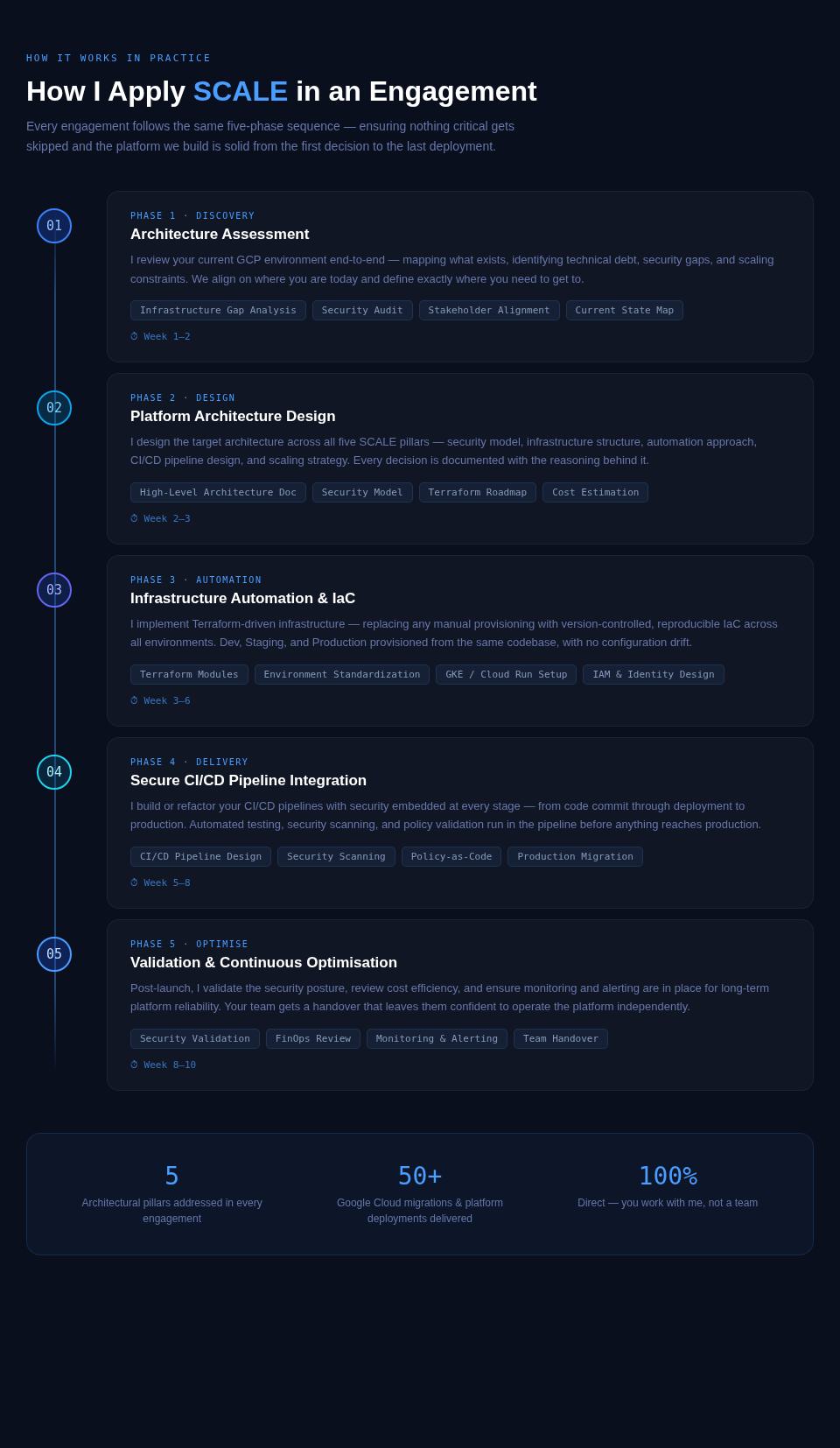
Every SCALE™ engagement follows the same five-phase sequence — not as a rigid process, but as a structured way of ensuring nothing important gets skipped.
- Architecture Assessment — I review your current GCP environment, identify technical debt, security gaps, and scaling constraints. We align on where you are and where you need to get to.
- Platform Design — I design the target architecture across all five SCALE pillars — security model, infrastructure structure, automation approach, delivery pipeline design, and scaling strategy.
- Infrastructure Automation — I implement Terraform-driven infrastructure, replacing any manual provisioning with version-controlled, reproducible IaC across all environments.
- Secure Delivery Integration — I build or refactor your CI/CD pipelines with security embedded at every stage — from code commit through deployment to production.
- Continuous Optimisation — Post-launch, I validate security posture, review cost efficiency, and ensure monitoring and alerting are in place for long-term platform reliability.
Is the SCALE Framework Right for Your Situation?
The SCALE™ framework is most valuable in these six situations:
- You’re building a new SaaS or digital platform and want to get the architecture right from the start — not refactor it in 18 months.
- You’re modernizing legacy infrastructure and need a structured, low-risk migration path that doesn’t disrupt production.
- Your cloud environment has grown organically and you’re dealing with drift, inconsistency, and security gaps you can’t fully map.
- You need to implement DevSecOps and CI/CD automation but don’t know where to start or how to embed security without slowing delivery.
- You’re managing multiple teams or environments and need a standardized platform foundation everyone can work from.
- Your cloud costs are growing faster than your business and you need visibility and control without sacrificing reliability.
Apply the SCALE Framework to Your GCP Platform
If any of the five SCALE pillars describe a gap in your current platform — or if you’re starting from scratch and want to build on a solid foundation — let’s talk. I’ll start with a free 30-minute architecture review where we look at where you are, identify the most urgent gaps, and map out what a SCALE-driven platform would look like for your specific situation.
Ready to Build a Platform That Scales Without the Tech Debt?
